DarkMatch: AI-Powered Identity Resolution

DarkMatch outperforms 15 leading identity resolution providers with 28.68% higher match rates and 32-47% reduction in false duplicates. Our multi-stage engine doesn't just match text strings, it understands identity.
How DarkMatch Works

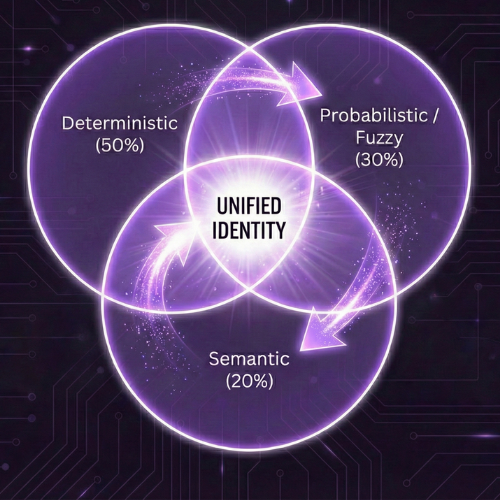
DarkMatch combines three complementary approaches in a cascading pipeline, each layer catching matches the previous layer missed:

Stage 1: Augmented Deterministic Matching

Leverages rule-based logic enhanced by ML-based scoring to weight high-value identifiers like SSNs. This stage efficiently resolves 50% of records using intelligent, statistical confidence thresholds.

Stage 2: Probabilistic Fuzzy Matching

Deploys the Fellegi-Sunter model and EM algorithms to calculate match probabilities without unique identifiers. It resolves an additional 30% of records through unsupervised learning and behavioral correlations.

Stage 3: AI-Powered Semantic Matching

Resolves the final 20% of complex edge cases using LLMs to analyze "Semantic Gravity" and behavioral clusters. This stage uses human-level contextual reasoning to bridge gaps in fingerprints and location history.
How DarkMatch Works - Stage 1: Augmented Deterministic Matching The process begins with rule-based deterministic matching, enhanced by an ML-based scoring mechanism. This mechanism assigns dynamic scores to attributes and derived rules—weighing a match on Social Security Number higher than Phone Number, for example. Intelligent thresholds augment traditional rules with statistical confidence rather than binary pass/fail logic. This stage handles approximately 60% of records where strong identifiers exist. Stage 2: Probabilistic Fuzzy Matching For records that don't trigger deterministic matches, DarkMatch deploys our high-performance probabilistic record linkage library implementing the Fellegi-Sunter model. Using Expectation Maximization (EM) algorithms, it performs unsupervised learning on the dataset to calculate match probabilities even when unique identifiers are missing. This stage resolves approximately 30% of records through statistical inference on name similarity, address proximity, and behavioral correlation. Stage 3: AI-Powered Semantic Matching The final 10% of records—the hardest edge cases—are resolved through DarkMath's proprietary LLMs analyzing Semantic Gravity. Rather than comparing strings, the system analyzes behavioral and semantic clusters. Two records with different names but identical spending patterns, device fingerprints, and location histories are recognized as the same identity. The AI asks contextual questions ("Are '123 Main St, Suite A' and '123 Main St #A' the same location?") to resolve ambiguity with human-level understanding.

Turn Fragmented Data into Unified Profiles

DarkMath uses vector embeddings and Semantic Gravity to unify fragmented customer data into a single Golden Record. In head-to-head testing against 15 leading identity resolution providers, DarkMath achieved 86.44% F1 accuracy, a 19.82% improvement over the nearest competitor.
  • 40-50% Higher Match Rates: Find connections that string-matching systems miss through semantic understanding.
  • 22% Audience Expansion: Reach qualified prospects with missing data through semantic attribute inference.
  • $2.7 million saved: Revenue generated through audience expansion
  • Solve the $1 Billion Identity Crisis: Nearly 1 in 4 enterprise customer profiles contain critical errors. DarkMath fixes fragmentation at the source.
Competitor Comparison
Performance Metric
Our Score
Competitor Score
Our Advantage
vs. A National Data Company
F1 Score (Accuracy & Balance)
86.44%
72.14%
19.82%
Improvement
Match Rate
78.96%
61.36%
28.68%
Improvement
vs. A Prominent Brand CDP
F1 Score (Accuracy & Balance)
83.42%
68.86%
21.14%
Improvement
Match Rate
72.22%
54.91%
31.5%
Improvement
vs. An International Audience Creation Company
Total Households(Reach)
10,838,389
6,992,837
55% More Reach (+3.8M)
Household Precision(Max Size)
37(Realistic)
994
(False Positives)
Eliminated
Mega-Clusters
Duplicate ID
Detection
26.91%
0%
(Baseline)
Found 2.7M Duplicates

The Golden Record Output

DarkMatch produces a unified "Golden Record" for each resolved identity, a single, authoritative profile that consolidates all touchpoints. The Golden Record includes confidence scores, source attribution, and a full audit trail showing which records were merged and why. This enables:
  • True Customer 360: See complete purchase history, preferences, and interactions across all channels
  • Accurate LTV Calculation: Understand actual customer lifetime value when fragmented transactions are unified
  • Personalization at Scale: Deliver relevant experiences based on complete behavioral history

DarkMatch FAQs

What data formats does DarkMatch accept?

DarkMatch accepts CSV, JSON, Parquet, and direct database connections. We support batch file uploads, SFTP transfers, S3 bucket sharing, Snowflake table sharing, and REST API integration. No proprietary formats or custom connectors required.

How does DarkMatch handle the 'John Smith Problem'?

Common names are the Achilles heel of traditional matching. DarkMatch treats each identity as a vector centroid and analyzes the full constellation of attributes: spending habits, device usage, location patterns, and life stage. Two "John Smiths" at the same address, father and son, are separated with 99% confidence based on behavioral divergence. The system detects two distinct gravity wells rather than forcing a false merge.

Detailed Example: Semantic Generational Resolution
Consider two records: both "John Smith" at "456 Oak Lane" with the same last name and address. Traditional systems fail here, they either incorrectly merge (corrupting the profile) or require a human to manually review. DarkMath's semantic attribute engine, trained on billions of records with known demographics, identifies the generational signature of each record. Record A shows: TikTok app engagement, Instagram activity, Venmo transactions, casual text syntax with abbreviations ("u" instead of "you"), high emoji frequency, Spotify streaming, and mobile-first browsing. These signals map to Gen Z behavioral patterns. Record B shows: Facebook-primary social engagement, formal email communication, desktop browsing preference, traditional banking app usage, cable TV indicators, and established brand purchasing patterns. These signals map to Boomer generation patterns. Without any explicit "Junior" or "Senior" or age field, DarkMath separates these identities through semantically-trained generational attributes—turning what would be a false merge into two distinct, accurate Golden Records.

Can DarkMatch integrate with my existing matching system?

Yes. DarkMatch is designed to complement existing systems, not replace them. You can run DarkMatch on records that your current system couldn't resolve, use it as a validation layer, or gradually migrate matching logic. Most customers start with a proof-of-concept on a subset of data before full integration.

How do you train your semantic matching models?

DarkMath uses "The Corruptor"—a proprietary synthetic data engine that generates training data by systematically introducing realistic variations into known ground truth records: typos, transposition errors, nickname substitutions, format inconsistencies, and missing fields. This creates massive, unbiased training sets that are mathematically representative of real-world data chaos but free from privacy concerns and historical biases.

Transform your data into Revenue today with DarkMatch

Experience immediate impact with our straightforward integration process and easily measure the benefits of DakMatch